


Cambridge Spies Explained Through Five Betrayals

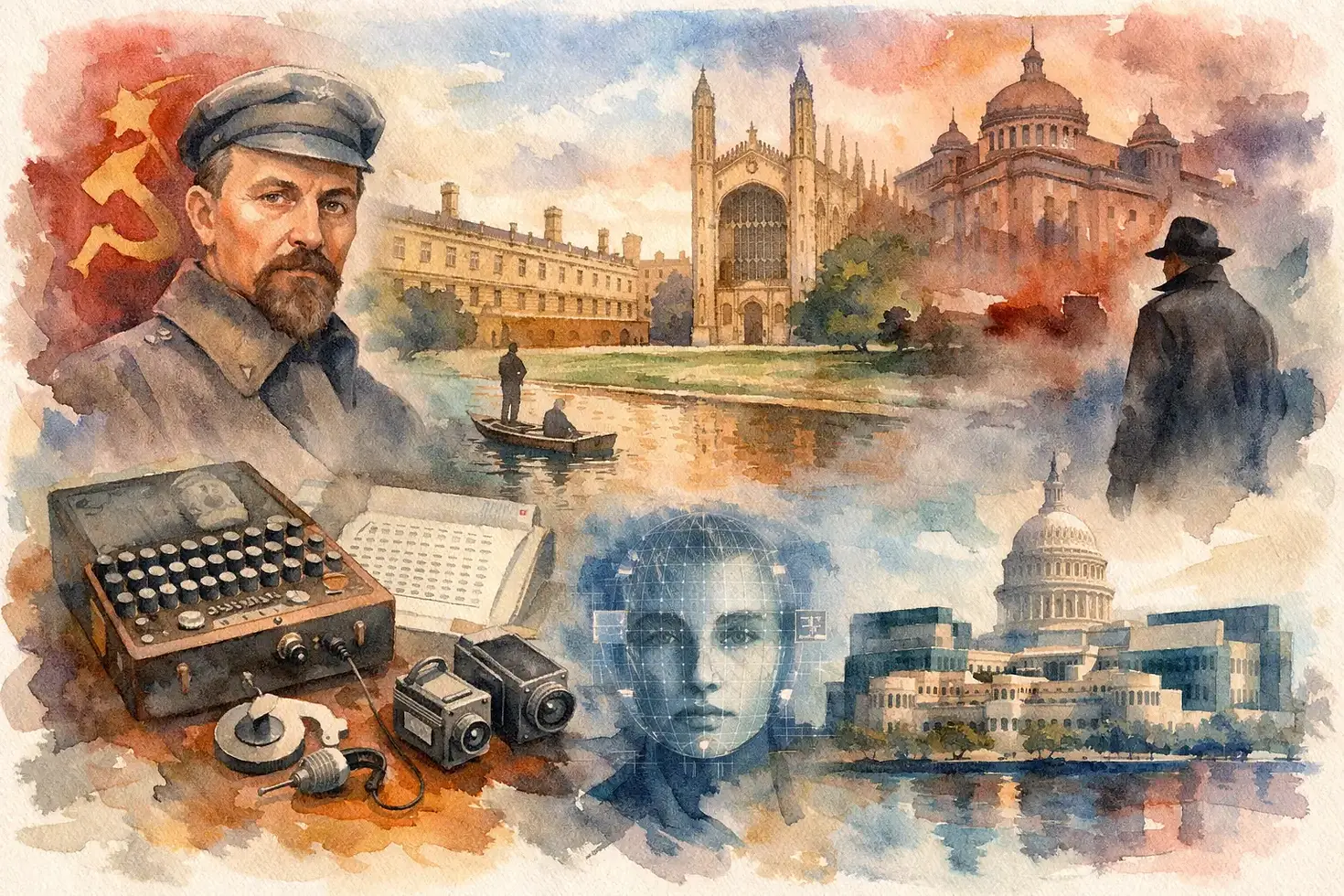
The Cambridge spies explained in one sentence are this: a group of gifted, well-connected British men were recruited by Soviet intelligence in the 1930s, then spent decades betraying the institutions that had welcomed them. But that sentence is too neat. Their story is not simply one of ideology or treason. It is a case study in class, confidence, institutional blindness and the long afterlife of secrets.
The label ‘Cambridge Five’ suggests a disciplined unit, meeting in shadowy rooms and working to a shared plan. The reality was messier. Kim Philby, Guy Burgess, Donald Maclean, Anthony Blunt and John Cairncross followed different paths through the British establishment. They did not all know one another’s operational details, and their handlers kept them compartmented. What united them was their recruitment while connected to Cambridge University, their commitment to the Soviet cause, and their access to material that should never have crossed Britain’s frontiers.
Cambridge spies explained: why they were recruited
The Soviet services were not interested in undergraduate theatrics. They were looking for people who could spend years climbing into the Foreign Office, the intelligence services, the BBC, the Treasury and the private offices where policy was formed. Cambridge offered an unusually fertile environment. In the early 1930s, European politics had radicalised a generation, and communism could appear to some students as an answer to economic collapse, fascism and what they saw as the hypocrisy of the ruling class.
Soviet intelligence recruited selectively. Its officers did not necessarily want public firebrands. A conspicuous communist was unlikely to be trusted with sensitive work. The more valuable prospect was someone prepared to abandon overt politics, cultivate respectability and become indistinguishable from the establishment. That was the essential deception. The men did not infiltrate Britain by pretending to be loyal later in life. They built careers in which loyalty was assumed from the beginning.
This point matters because it corrects a common misconception. A mole is not merely an outsider who steals secrets. A mole is recruited before or after entering an organisation, then becomes part of its trusted machinery. The danger is not just access to documents. It is access to judgement: who is appointed, which reports are believed, what operation is approved, and which colleague is quietly marked as suspect.
Five men, different damage
Kim Philby was the most consequential of the group. He entered Britain’s Secret Intelligence Service, commonly known as MI6, and rose to senior positions in sections concerned with Soviet affairs. He was not a minor clerk with a filing key. He occupied roles that gave him insight into British and American intelligence priorities, and he was able to pass vast quantities of material to Moscow.
Philby also demonstrated the most damaging quality in an agent: the ability to shape the enemy’s view of reality. Intelligence failures are often imagined as missing information. In Philby’s case, accurate information was supplied to Britain and its allies, but he was positioned to know how they would respond. Covert efforts directed against communist regimes in Eastern Europe were compromised, with severe human consequences for those involved. He later fled from Beirut in 1963, after years of suspicion, denial and protection by those reluctant to accept what was in front of them.
Donald Maclean worked in the Foreign Office and later held a post in Washington. His access made him extraordinarily valuable. He reported on high-level diplomatic exchanges and Anglo-American policy. Guy Burgess, brilliant, reckless and often appalling in behaviour, moved through the BBC and the Foreign Office. He was less careful than Philby, but his connections and charm made him useful - and, for too long, tolerated.
Anthony Blunt served in MI5, Britain’s Security Service, during the Second World conflict, before becoming Surveyor of the King’s Pictures. His later public standing was part of the scandal. He confessed privately in 1964 and received immunity from prosecution in exchange for co-operation, but his role was not publicly exposed until 1979.
John Cairncross, the most debated member of the supposed five, worked in the Foreign Office, the Treasury and at Bletchley Park. He admitted passing material to the Soviets. The degree to which he belonged to a single, coherent ‘five’ has always been less tidy than popular retellings suggest. That ambiguity is instructive. Intelligence history rarely arrives with a cast list and a final, uncontested script.
Why Britain failed to see them
The first answer is painfully simple: they looked right. They possessed the accents, schools, manners and references that encouraged gatekeepers to relax. In an age when security vetting was less systematic, social familiarity could be mistaken for reliability. The same networks that opened doors also discouraged hard questions.
But class prejudice alone does not explain the failure. There were warning signs. Burgess’s conduct was erratic. Philby attracted suspicion after Burgess and Maclean vanished in 1951, escaping to Moscow before Maclean could be confronted. Yet suspicion is not proof, and institutions dislike conclusions that will disgrace senior figures, expose earlier errors and rupture relations with allies.
The VENONA decrypts made the picture clearer. VENONA was an American and British effort to read portions of Soviet intelligence traffic after errors in Soviet cryptographic practice allowed some messages to be broken. The decrypts did not hand investigators a convenient confession. They were fragmentary, coded and slow to interpret. Yet they helped identify Maclean as a Soviet source and revealed the depth of the penetration.
That is another enduring lesson. Counter-intelligence is not a clean contest in which a clever investigator spots a liar. It involves partial evidence, competing agendas and the risk of accusing an innocent person. MI5 had to protect Britain from penetration while working alongside MI6, an organisation badly compromised by Philby. Any service can become defensive when the threat may be sitting in its own senior ranks.
The real legacy of the Cambridge Five
The Cambridge affair damaged confidence between Britain and the United States, especially with the Central Intelligence Agency, or CIA. It exposed sensitive sources, methods and liaison reporting. More profoundly, it showed that intelligence services can be defeated by assumptions about their own people.
The Soviet service later known as the KGB, the Committee for State Security, gained far more than secret papers. It received a continuing account of what Britain and its allies knew, feared and planned. A well-placed source lets an adversary measure the effects of its own deception. If a forged report is believed, if a source is suspected, if an operation is being prepared, the mole can report the reaction. That feedback is priceless.
The affair also distorted British public life for years. The search for traitors encouraged genuine counter-intelligence work but also fuelled rumour, score-settling and a tendency to see every failure as the product of conspiracy. Both errors are dangerous. Naivety leaves a service exposed; paranoia corrodes judgement and can destroy innocent careers.
For readers of espionage fiction, the Cambridge Five endure because they challenge the easy moral geometry of the genre. These were not glamorous adventurers operating beyond the state. They were cultivated men inside the state, exploiting friendships and institutions built on trust. Their betrayals were personal as well as political. A colleague who shared a drink, recommended a candidate or defended a friend could become an unwitting part of the operation.
For a detailed account of Philby’s particular damage, Ben Macintyre’s A Spy Among Friends: Philby and the Great Betrayal remains a compelling starting point. Christopher Andrew’s The Defence of the Realm: The Authorised History of MI5 gives the broader institutional context, while The Mitrokhin Archive by Christopher Andrew and Vasili Mitrokhin reveals the scale and ambition of Soviet intelligence from a different angle.
The enduring truth is uncomfortable: secret services cannot function without trust, yet trust is precisely what a skilled penetration turns into a weapon. Subscribe via the homepage and download a free copy of Emperor for an intelligence thriller rooted in that same hard terrain of loyalty, power and betrayal.


Comments