


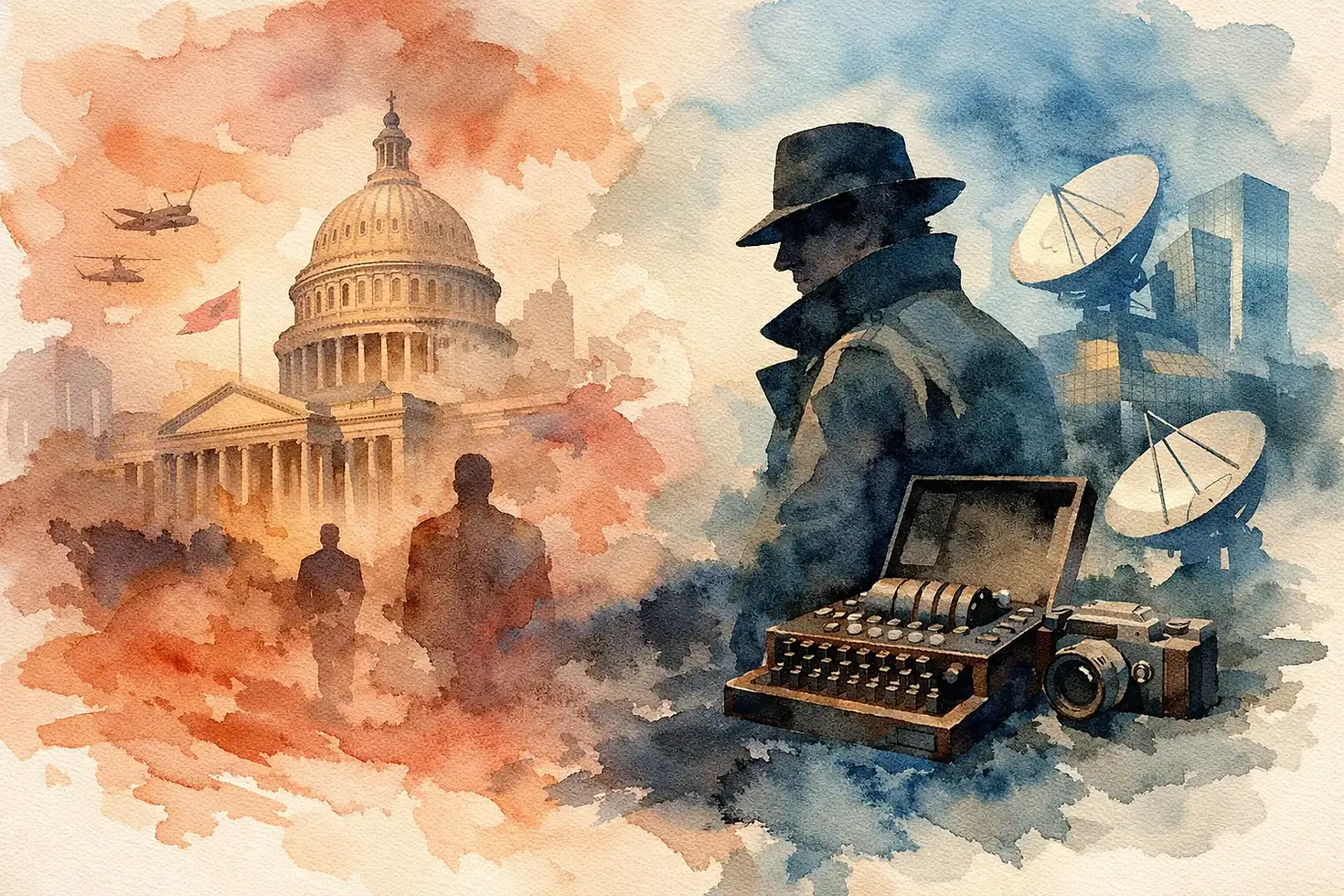
Political Suspense Versus Spy Fiction Compared

A cabinet minister receives a classified briefing that could end a government. Across town, an asset waits for a signal from a handler who may already have betrayed him. Both scenes can generate fear, pace and consequence. Yet political suspense versus spy fiction turns on a fundamental question: is the story chiefly about the exercise of power, or the covert acquisition of information that makes power possible?
The boundary often blurs. The strongest thrillers use both forms because governments do not make grave decisions in a vacuum, and intelligence work exists to influence or inform those decisions. But each genre has its own engine, its own moral terrain and its own kind of jeopardy.
Political suspense puts institutions under pressure
Political suspense begins where public authority becomes vulnerable. Its central figures tend to be ministers, civil servants, journalists, judges, military commanders, party operators or corporate figures close to government. The threat may be a coup, an election scandal, corruption inquiry, constitutional crisis, assassination plot or an international confrontation that divides a cabinet.
The key tension lies in competing loyalties. A politician may protect the country while destroying a colleague. A reporter may expose a crime yet trigger violence. A senior official may bury a truth because disclosure would break an alliance. The protagonist need not carry a false passport or recruit an agent. He or she must instead survive the machinery of the state: committees, leaks, party whips, hostile newspapers, security briefings and private bargains made behind respectable doors.
Real history supplies ample material. The Profumo affair showed how sex, secrecy and Cold War anxiety could destabilise British political life. Watergate demonstrated that a government can be undone not by an enemy service but by its own appetite for control and its inability to contain a cover-up. The 1991 Soviet coup attempt exposed a state in which factions of the security apparatus, military and party fought over the future of the regime itself.
Political suspense works when procedure becomes dramatic. A meeting room can carry as much danger as a border crossing if the reader understands what one signature, leaked memorandum or withheld intelligence assessment will cost. The genre asks who truly governs, whose interests the state protects, and how far decent people will travel to retain office or avert catastrophe.
Spy fiction makes secrecy personal
Spy fiction narrows the lens. It places the reader beside the person who must steal, conceal, recruit, deceive or escape. Its essential currency is tradecraft: surveillance detection routes, dead drops, clandestine meetings, cover identities, compromised communications and the fraught relationship between an agent and a handler.
The protagonist may serve MI6, Britain’s Secret Intelligence Service, the CIA, the United States’ Central Intelligence Agency, or France’s DGSE, the Directorate-General for External Security. They may work against MI5, Britain’s Security Service, which handles domestic security, or struggle with material gathered by GCHQ, the Government Communications Headquarters, Britain’s signals intelligence agency. Acronyms matter less than the human reality beneath them. Every service relies on people who can be bought, pressured, flattered, frightened or persuaded that betrayal serves a greater cause.
That is why the best spy fiction rarely treats espionage as a gadget show. A source who risks a career, family or life cannot become a plot device. The officer handling that source faces a brutal calculation: protect the individual, preserve access, or pursue intelligence that may save many others. There is no clean answer.
Kim Philby remains the enduring example of the damage one trusted insider can inflict. His penetration of British intelligence gave Moscow insight into Western operations and exposed agents to terrible danger. Ben Macintyre’s A Spy Among Friends: Philby and the Great Betrayal captures the social confidence and institutional blindness that helped him prosper. The lesson for fiction is not that traitors are superhuman. It is that systems grant trust, and trust creates opportunity.
Where political suspense and spy fiction meet
The distinction becomes most useful when it clarifies stakes. In spy fiction, the immediate question is often whether the agent can obtain the secret or survive the operation. In political suspense, the question is what happens after the secret reaches the people who can use it.
A defector may carry proof that an adversary plans an intervention. That is spy fiction. A prime minister who must decide whether to reveal the intelligence, act upon it, or question its reliability has entered political suspense. The first story follows concealment. The second follows consequence.
The most satisfying novels build a bridge between them. The operative’s action should alter a political calculation, while the political decision should place new pressure on the operative. A fabricated intelligence report can begin as a bureaucratic fraud and end with a field officer abandoned in hostile territory. A minister’s need for plausible deniability can turn an agent from valued asset into expendable liability.
This is where realism earns its keep. Intelligence does not operate outside politics. Services compete for budgets, access and influence. Leaders can ignore sound reporting because it clashes with a chosen policy. Intelligence can prevent strategic surprise, but it cannot compel wisdom.
The real services offer richer conflict than stereotypes
Russian intelligence illustrates the value of institutional detail. The SVR, Russia’s Foreign Intelligence Service, inherited much of the KGB’s foreign intelligence role. The FSB, Federal Security Service, handles domestic security and counter-intelligence. The GRU, military intelligence, has built a reputation for aggressive operations. Their rivalries and overlapping priorities create more credible drama than a single all-powerful Moscow headquarters.
China presents an equally complex picture. The Ministry of State Security, or MSS, known as the Guoanbu, leads foreign intelligence and counter-intelligence work. The Ministry of Public Security, the Gonganbu, controls policing and internal security functions. The United Front Work Department builds influence through political and social networks, while the People’s Liberation Army, or PLA, has used the Political Work Department in its covert architecture. The Strategic Support Force adds a military dimension to information and cyber operations.
None of this means a novelist needs to turn a chapter into an intelligence directory. It means the pressure should arise from how institutions behave. A service seeks sources. A ruling party seeks control. A military command seeks advantage. Their priorities may coincide, then collide. That collision gives political suspense and spy fiction their force.
Successes, failures and regime change
Fiction gains depth when it recognises that intelligence successes often remain invisible, while failures arrive with names, inquiries and funerals. The British breaking of German Enigma traffic at Bletchley Park gave Allied leaders a major advantage during the Second World War, though it did not replace military judgement or sacrifice. Soviet intelligence’s penetration of the Manhattan Project delivered atomic secrets to Moscow and changed the strategic balance after the war.
Failures can prove more revealing. The Bay of Pigs invasion in 1961 exposed poor assumptions, political pressure and disastrous planning. The absence of weapons of mass destruction in Iraq after the 2003 invasion showed how intelligence assessment can be distorted when leaders demand certainty from incomplete evidence. Such cases belong naturally in political suspense because the failure does not end with the operation. It spreads through parliaments, alliances, public trust and the lives of those sent to fight.
Intelligence services have also enabled regime change, directly or indirectly. The CIA and MI6 played roles in the 1953 overthrow of Mohammad Mossadegh in Iran. The consequences travelled far beyond the operation’s immediate success. The Soviet security system helped preserve authoritarian rule across Eastern Europe, but its coercive reach also produced resistance and mistrust that weakened the system over time. Political power may use secret action to secure an outcome. It cannot control the history that follows.
For readers who want the factual foundations beneath the fiction, Richard J. Aldrich’s GCHQ, Christopher Andrew’s The Defence of the Realm: The Authorised History of MI5, Philip H. J. Davies’ MI6 and the Machinery of Spying, and The Mitrokhin Archive by Christopher Andrew and Vasili Mitrokhin provide serious starting points. Owen Matthews’ An Impeccable Spy, Richard Faligot’s Chinese Spies, and Michael Smith’s The Anatomy of a Traitor add cases where ideology, ambition and personal weakness shape the hidden war.
Which form should a thriller choose?
Choose spy fiction when the moral weight rests on a clandestine relationship: the recruited insider, compromised officer, defector or double agent. Choose political suspense when the decisive struggle occurs among those who direct the state and manage the fallout. Choose both when the secret operation and the political decision are inseparable.
The reader should feel that every act has a price. A stolen document may change a government’s course. A minister’s lie may leave an agent to face the consequences alone. That is the common ground between the genres: not spectacle, but power exercised in darkness and paid for by real people.
For more intelligent espionage fiction shaped by the realities of power, loyalty and betrayal, subscribe through the homepage and download a free copy of Emperor.



Comments