


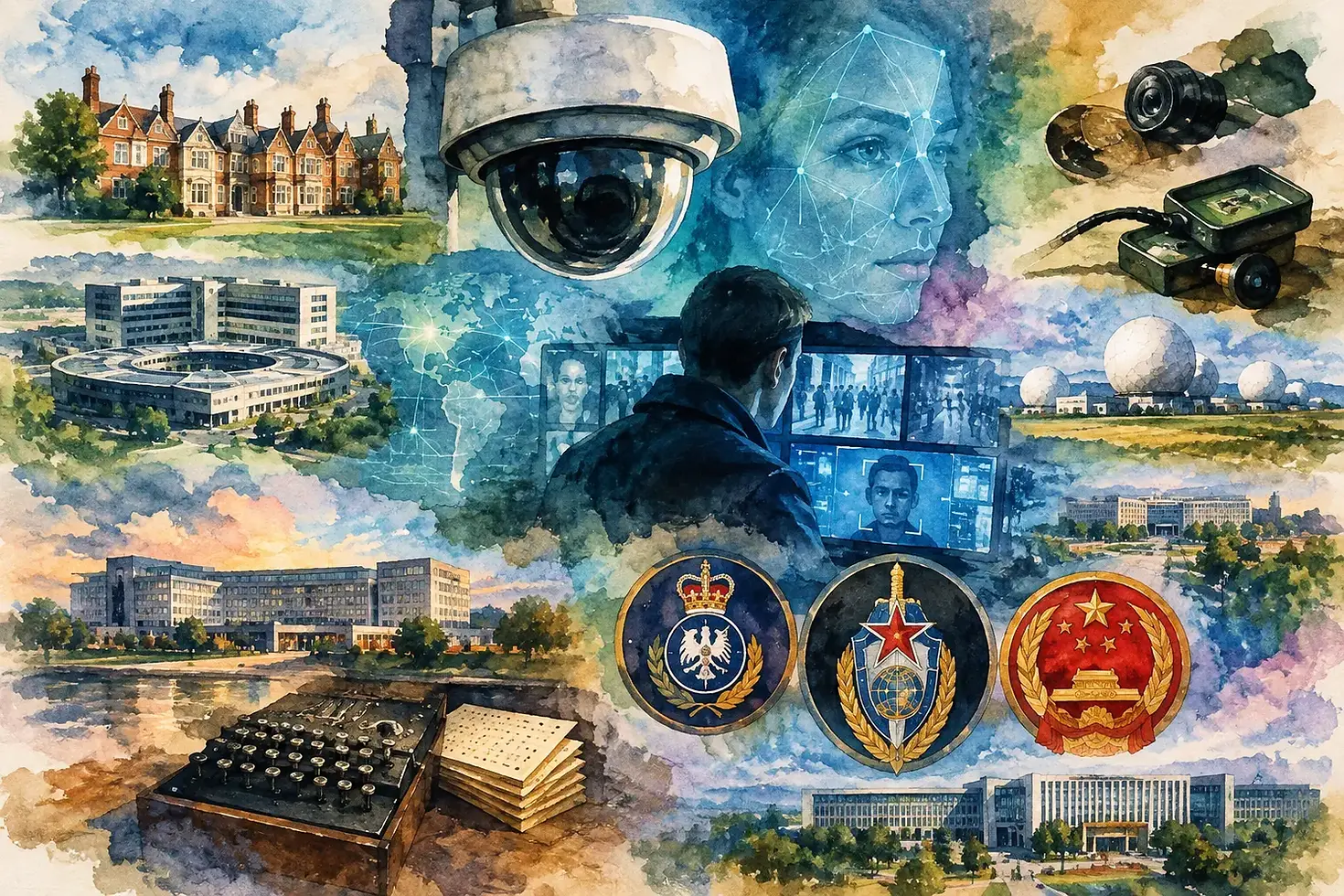
Surveillance Technology in Thrillers That Works

A phone left face-down on a café table is no longer merely a prop. It is a witness, a locator beacon, a contact book, a microphone and, in the right hands, the beginning of an accusation. Surveillance technology in thrillers has changed the mechanics of suspense: the operative who once feared a man in a raincoat must now fear the ordinary systems that record everyone.
That does not mean every modern thriller needs pages of technical jargon or a magical screen that reveals the villain's every move. Quite the opposite. The best surveillance stories understand that technology produces vast quantities of partial information. The tension lies in who can interpret it, who can corrupt it, and whether a character realises they are being watched before it is too late.
Why surveillance technology in thrillers matters
Classic espionage fiction made surveillance physical. A watcher had to be patient, discreet and close enough to lose his target at the first bad turn. That human danger remains powerful, but it now operates alongside CCTV, automatic number-plate recognition, mobile phone location data, facial-recognition systems, hacked accounts and commercial data brokers.
The change is political as well as dramatic. Surveillance is no longer confined to intelligence services. Private companies retain location histories, advertising networks build behavioural profiles, and an ordinary smart doorbell may provide footage that changes an investigation. A credible thriller recognises this spread of power. The state may possess exceptional reach, but a corrupt contractor, a hostile insider or an ambitious private investigator may possess enough access to ruin someone.
For the writer, this creates a useful pressure. Characters cannot simply disappear by putting on a hat and catching a train. They need to consider patterns: who they spoke to, which devices travelled with them, whether a car has been recognised, and what a routine search might reveal about their intentions. Yet they also need room to act. If technology makes escape impossible, the plot dies.
Surveillance is powerful, not omniscient
The weakest techno-thrillers treat a database as an oracle. An analyst types a name, presses return and receives the truth. Real intelligence work is less obliging. Data can be old, wrongly attributed, incomplete or deliberately planted. A facial-recognition match is a lead, not a conviction. A handset near a crime scene may belong to a passer-by, a stolen phone or someone whose presence is easily explained.
This uncertainty is where good fiction gets its bite. A protagonist may know that their movements have been captured but not know who requested the footage. An analyst may find a pattern in metadata, then discover it has been manufactured to send the service in the wrong direction. The reader should feel the tightening net without being asked to believe in supernatural technology.
From PRISM to XKeyscore: use real systems carefully
Public disclosures have given thriller writers a vocabulary that would once have sounded fanciful. PRISM was a United States National Security Agency, or NSA, collection programme associated with obtaining communications data from major internet companies under legal authorities. XKeyscore, also linked to the NSA, was reported as a system for searching and analysing large volumes of collected internet data.
Such names carry narrative force because they point to an uncomfortable fact: modern collection often concerns scale, connection and pattern rather than a single agent listening to a single telephone call. Stellar Wind was the codename for a secret US surveillance programme initiated after the attacks of 11 September 2001. Trailblazer was an NSA initiative intended to address the collection and analysis of digital communications, later notorious for its cost and controversy.
A novelist need not turn these programmes into a lecture. One precise reference, used by a character who understands its limits, is usually more convincing than a page of acronyms. Programmes change, authorities differ and public reporting is incomplete. The writer's task is not to claim access to hidden files. It is to show what a system of mass collection does to trust, privacy and institutional judgement.
The same caution applies to newer algorithmic systems. Reports around projects such as Lavender and Lanius have intensified public concern about automated targeting and data-driven identification in conflict zones. In fiction, the compelling question is not whether an algorithm is clever. It is who selected its data, who set its threshold for suspicion, and who carries responsibility when it is wrong.
The human beings behind the screen
The most chilling surveillance scenes are rarely about equipment. They are about hierarchy. Somebody decides that a person merits attention. Somebody else signs the authority, interprets the result or chooses not to ask where the information came from.
Britain's Secret Intelligence Service, commonly known as MI6, gathers intelligence abroad. MI5 is Britain's Security Service, focused on threats to national security within the United Kingdom. GCHQ, the Government Communications Headquarters, specialises in signals intelligence and cyber activity. Their American counterparts include the CIA, the Central Intelligence Agency, and the NSA. France's DGSE is the Direction Générale de la Sécurité Extérieure, its external intelligence service.
These distinctions matter in a thriller because institutions have mandates, rivalries and legal constraints. A source may be useful but politically inconvenient. One service may hold a fragment another needs, while senior officials worry more about embarrassment than accuracy. Technology does not abolish office politics. It gives office politics more sensitive material to mishandle.
That is why a surveillance operation works best when it creates a moral choice. Does an officer protect a source whose private messages expose an affair? Does a junior analyst challenge a flawed assessment when the senior team wants a quick answer? Does a politician demand access to information that was collected for a different purpose? The machine supplies pressure; character provides the consequence.
How the best thriller writers keep it credible
Len Deighton understood that intelligence is often a matter of bureaucracy, ego and compromised loyalties rather than glamorous certainty. Mick Herron finds dark humour in institutional incompetence and the human debris left by secret work. Charles Cumming combines contemporary tradecraft with political calculation, while Mai Jia examines secrecy, codes and the psychological isolation of intelligence work from a Chinese perspective. Alma Katsu brings an unsettling interest in power, memory and concealed motives.
Their methods vary, but the enduring lesson is the same: surveillance should alter behaviour. A character who believes their phone is compromised will not merely buy a new handset and carry on. They may stop calling a lover, avoid a trusted colleague, become suspicious of coincidence and make a fatal mistake through loneliness. The device is not the story. Its effect on the person is.
For readers who want the factual foundations beneath the fiction, Richard J. Aldrich's GCHQ, Keith Jeffery's MI6: The History of the Secret Intelligence Service, and Christopher Andrew's The Defence of the Realm: The Authorised History of MI5 show how intelligence organisations grow through technology, crisis and secrecy. Philip H. J. Davies's MI6 and the Machinery of Spying is particularly valuable on the systems and structures that sit behind the legend.
A better kind of modern suspense
The temptation is to make surveillance ever more total: a city mapped by cameras, every message recovered, every face identified. But total knowledge is dramatically dull. The sharper choice is to make information abundant and judgement scarce.
A camera catches the wrong angle. Location data identifies the wrong device. An artificial intelligence system flags the innocent person whose habits resemble a dangerous one. Meanwhile, the individual who matters has anticipated the obvious measures and exploited the organisation's blind spots. This is not a loophole. It is the real terrain of suspense: imperfect systems operated by fallible people under pressure.
The next great surveillance thriller will not be about a machine that sees everything. It will be about the dangerous confidence of those who think it does.
For more intelligent espionage fiction shaped by secrecy, loyalty and political power, subscribe for updates and download a free copy of Emperor.

Comments