


is nuclear deterrence obsolete?
- John Fullerton
- Jun 5
- 6 min read
Britain’s strategy of nuclear deterrence has never been aimed at the Soviet Union and its successor state, Russia. Instead, the UK’s political objective from the very beginning was always the United States.
Put bluntly, a missile carrying nuclear warheads bursting out of the North Atlantic on a trajectory to strike what was the Soviet Union within a matter of minutes could have been American or British (and later, French). The Russians wouldn’t be able to tell the difference, and by the time they did know, it would have been too late.
And that was the point.
In other words, London sought to tie Washington firmly to British national interests, whether the Americans shared British concerns and wanted this close alignment or not.
In impoverished, post-war Britain, overwhelmed by war debts and where food rationing was still in place, the options were grim. In 1946, Hugh Dalton, Chancellor of the Exchequer, and Sir Stafford Cripps, President of the Board of Trade, told Labour Prime Minister Clem Attlee they were strongly against the Bomb on grounds of cost.
That was until Ernest Bevin, the formidable Foreign Secretary, ambled into the Cabinet Room, explaining he’d had a heavy lunch and had fallen asleep.
Bevin didn’t agree with his colleagues. ‘No, Prime Minister, that won’t do at all. We’ve got to have this. I don’t mind for myself, but I don’t want any other Foreign Secretary of this country to be talked at, or to, by the Secretary of State in the United States as I just have in my discussion with Mr Byrnes. We’ve got to have this thing over here, whatever it costs.’
Bevin prevailed.
As journalist, historian and author Peter Hennessy has written, the UK could not afford to acquiesce in an American monopoly of this new technology. Attlee himself would later declare: ‘We had to hold up our position vis-a-vis the Americans. We couldn’t allow ourselves wholly to be in their hands…we had to bear in mind there was always the possibility of their withdrawing and becoming isolationist again…’
The United States, so powerful economically and militarily, had to be roped into securing Western Europe’s defence against Stalin’s Red Army.
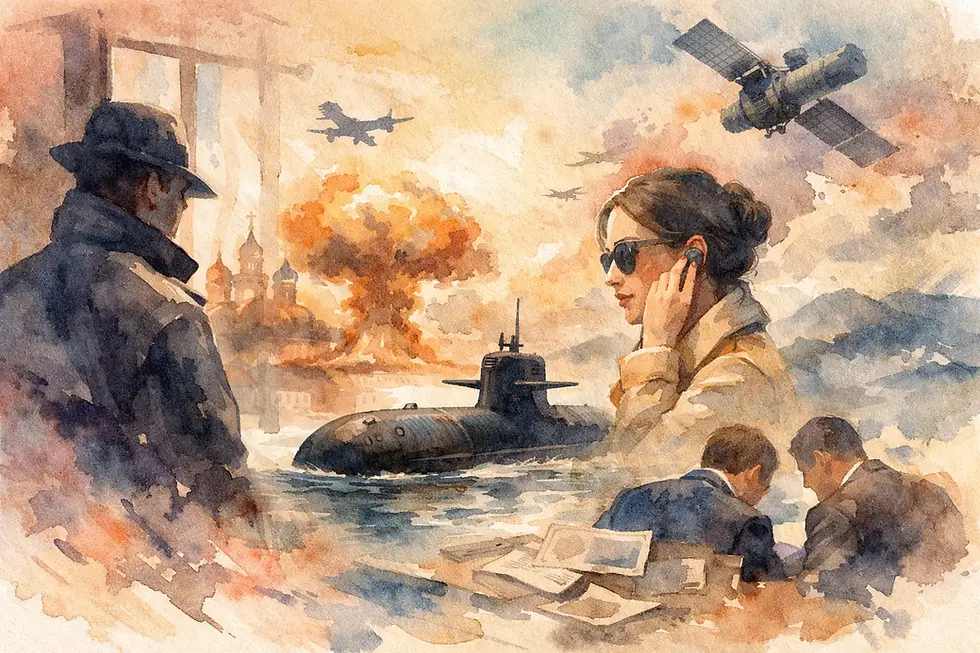
The British might come to rely on U.S. technology and manufacturing for most of their nuclear deterrent, but they retained the means to squeeze the nuclear trigger without U.S. permission, and that remains the case today, with four ageing strategic nuclear missile submarines of the Royal Navy, at least one of which is always on patrol, as it has been continuously since 1968.
(My only reason for wiring this blog, incidentally, is because it forms the backdrop to my new thriller, Oceans Deep, to be published by Collective Ink’s fiction imprint, Roundfire, in May next year.)
To work effectively, nuclear deterrence requires a tacit agreement between not just allies but potential enemies, a kind of rational understanding that an exchange of strategic nuclear missiles would cause unacceptable levels of destruction to human life, to both countries’s infrastructure, and to the planet generally.
Hence that sinister acronym, MAD, or mutually assured destruction, often credited with having kept the peace for decades.
But has it?
As a recent paper published by the Chatham House think-tank points out, the nuclear taboo has not been broken since atomic bombs were dropped on Hiroshima and Nagasaki in August, 1945. The stability between the superpowers since then is seen by some proponents of nuclear deterrence as evidence of its effectiveness.
That’s about as logical as my crediting the unused domestic fire extinguisher in my kitchen for the fact that my home hasn’t burned down since it was built in the 19th century.
Nuclear war, along with nuclear deterrence, is a specialist business and not the stuff of people’s armies of two world wars. It is led by intelligence and counter-intelligence. Stalin, for example, had a penchant for raw intelligence, and he interpreted what he read of translations of Kim Philby’s secret documents, stolen from the Joint Intelligence Committee (JIC) in London, as evidence of British and Americans preparations for war against Moscow.
The trouble was that the UK intelligence establishment wrongly attributed to Stalin and his intelligence analysts the kind of rational thinking and detachment to which they themselves aspired.
This asymmetry in perception was dangerous. It still is.
It doesn’t end there. In assessing the fall-out from the U.S. intelligence failure over North Korea’s invasion of the south in 1950, there was concern in London that it was Washington rather than Moscow that posed a real threat of igniting a nuclear war. Some U.S. officials had decided that a shooting war was inevitable, and that the U.S. must therefore launch a pre-emptive war.
In which case, it wouldn’t be Britain dragging the United States into a nuclear confrontation with Moscow, but Washington throwing London under the nuclear bus.
Achieving a ‘balance of terror’ between two nuclear-armed adversaries requires, in the words of Dr John Borrie, ‘that an opponent will act rationally, and that what each side needs to do is to ensure it is never the rational choice for their opponent to act in a way that would prompt nuclear retaliation.’
Easier said than done, especially when rival nuclear arsenals are in some cases controlled by narcissists and psychopaths.
Borrie again: ‘One person’s definition of careful is not necessarily the same as another’s… Each individual has a perception of risk that is at least partially subjective.’
Then there’s the inconvenient fact of not just two nuclear powers, but nine.
For several governments observing the current U.S/Israeli war of aggression against Iran, the lesson has to be that security isn’t achieved by signing treaties and abiding by U.N. Security Council Resolutions, but through the acquisition of nuclear weapons.
That figure nine seems likely to grow.
Already, media reports suggest North Korea seems bent on expanding its nuclear weapons capability in reaction to events in Ukraine and the Gulf.
If deterrence wasn’t difficult enough, the major nuclear powers have also modified their official nuclear doctrine. Both Moscow and Washington now say there are situations in which they would be justified in using nuclear weapons in response to a non-nuclear attack, perhaps by cyber weapons.
France, with its own, entirely indigenous nuclear deterrent in the form of six strategic nuclear ballistic submarines as well as nuclear-capable, carrier-based strike aircraft, has offered its non-nuclear EU allies protective coverage by the French nuclear umbrella — a complete break from the previous emphasis by Paris on sovereign nuclear independence.
Such a step offers France considerable political and diplomatic prestige, though it would seem to complicate nuclear command and control procedures. Britain, too, has increased its sub-strategic nuclear weapons stockpile so it can respond to limited, regional threats, and is in the process of acquiring nuclear-capable strike aircraft, the F-35A
In 2025, US nuclear weapons returned to the UK. Boeing C-17 Gobemaster 111 flights landing at RAF Lakenheath on 18 July and 25 July were assessed by analysts to be carrying B61 MoD 12 gravity bombs with a maximum yield of 50 kilotons. Preparations for nuclear weapons storage at the base have also been documented since 2023. The weapons can be carried by both the F-15E Strike Eagle and F-35A Lightning aircraft of the 48th Fighter Wing.
And the United States, led by a President who has repeatedly denigrated NATO and threatened to withdraw from the Alliance, has recently offered to forward deploy dual-capable weapons and warheads in more European states. These ‘forward deployments’ of U.S. nukes already apply to Belgium, Germany, Italy, the Netherlands, Turkey and the United Kingdom.
At the same time, the distinction between nuclear and non-nuclear weapons is becoming increasingly blurred.
‘Advancing technologies include highly precise low-yield nuclear weapons, cyber offensive capabilities, autonomous weapons and artificial intelligence-based decision systems, hypersonic glide vehicles, anti-satellite weapons, and missile defences,’ says the Chatham House paper.
‘Each of these capabilities, or the responses to their use, could blur the line between the use of conventional and nuclear weapons. This in turn could break down the distinction between nuclear and non-nuclear warfare.’
In 2018, the United States stated that ‘deterring nuclear attack is not the sole purpose of nuclear weapons’, and that nuclear weapons could be used to deter ‘significant non-nuclear attacks’
If nuclear deterrence is no longer an effective doctrine, what could replace it?
John Fullerton



Comments